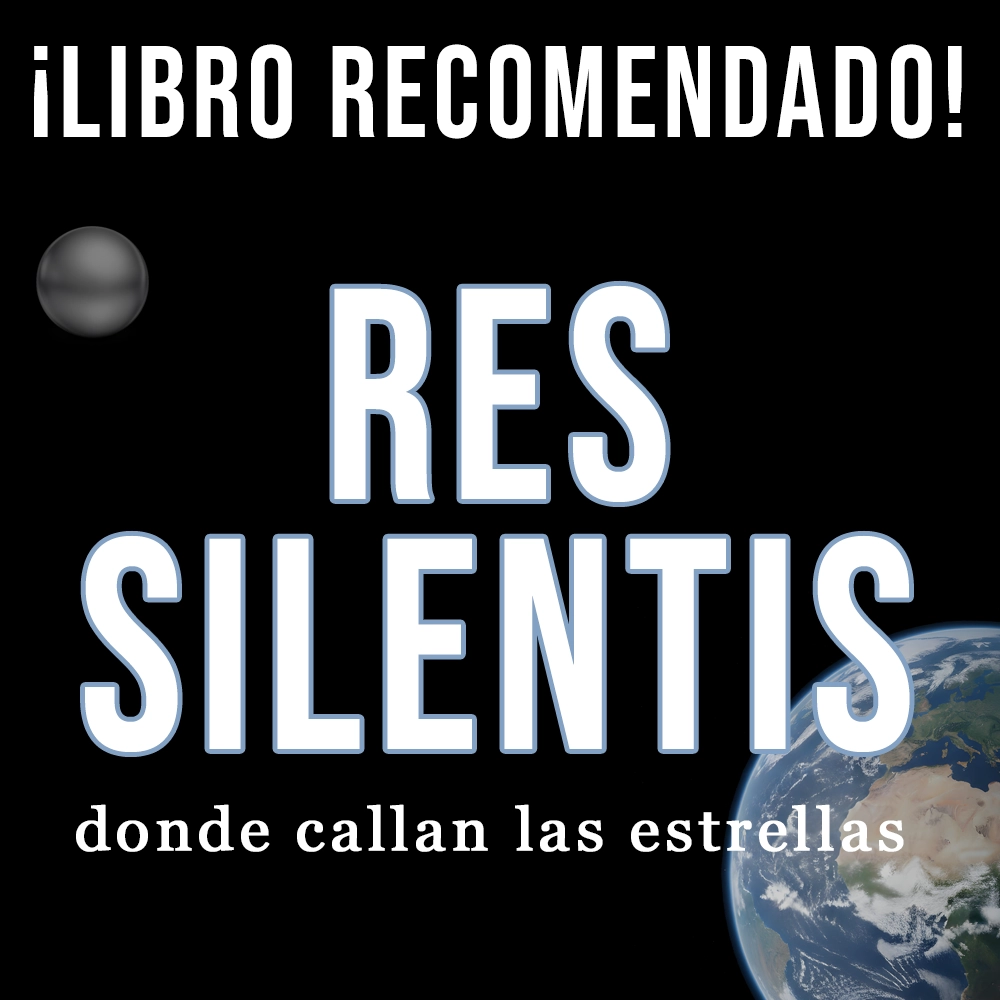
Hard sci-fi with a philosophical soul: the contact physics doesn’t forbid.
There is a graveyard 22,400 miles above your head. Not a metaphor. An actual place — the graveyard orbit, that silent band of space just above the geostationary belt where we send our dead satellites so they don’t collide with the living ones. We stuffed it full of our retired machines, our exhausted technology, our six-ton metallic ghosts. We called it a boneyard and stopped thinking about it.
Eduardo Garbayo thought about it. And what he found there — at least in the pages of Res Silentis — might be the most quietly terrifying, intellectually thrilling, and emotionally resonant premise in recent science fiction.
This is a first contact story. But before you reach for the alien invasion clichés, the flashing warships, the telegenic generals barking orders into headsets — stop. Put all of that down. Res Silentis is a first contact story told from the only angle that genuinely matters: the scientific one. Not what we hope alien life looks like. Not what Hollywood has trained us to fear. But what physics actually permits, what engineering would actually detect, and what the human mind — brilliant, tribal, fragile — would actually do the morning after
A Premise That Earns Its Silence
On August 22, 2026, a routine orbital cleanup mission — a garbage tug certifying the deaths of old satellites — picks up an anomaly on its synthetic aperture radar. The echo is too clean. No edges, no solar panels, no jagged debris profile. A sphere. Mathematically perfect. Three meters across. Parked in the middle of humanity’s cosmic junkyard, absorbing neither heat nor radar, emitting nothing, violating orbital mechanics simply by holding still.
It is there. It has always been there. We just weren’t looking.
What follows is not an adventure. It is an interrogation — of the object, and of ourselves. And Garbayo is disciplined enough to keep it that way.
The book opens not with the discovery, but with one of the most audacious prologues in recent memory: a full chapter tracing the arc of human space exploration, from that anonymous ancestor stepping out of a Pleistocene cave to stare at the Milky Way, through Galileo and Verne, the Wright brothers and Korolev, Laika and Katherine Johnson, Sputnik’s beep and Armstrong’s footprint. It reads like Carl Sagan and Bill Bryson got into a bar fight and both won. It is stirring and earned and — crucially — it is not decoration. It is the argument. It tells us exactly who we are before we meet something that might be something else.
The Science Is the Story
What sets Res Silentis apart from the crowded genre shelf is the same thing that separates great hard sci-fi from spectacle: the author does not skip the homework. Garbayo clearly has engineering in his blood. The orbital mechanics are real. The radar terminology is accurate. The orbital zone classifications — LEO, MEO, GEO, and the graveyard belt — are explained with the clarity of a gifted teacher, not the tedium of a textbook. When a character mentions the TIRA radar array in Wachtberg, Germany, or the GSSAP spy satellites the U.S. military uses to photograph competing assets from across the geostationary belt, you are not reading technobabble. You are reading research.
And yet — and this is the signature of genuine literary hard sci-fi — the technical rigor never crowds out the wonder. It produces the wonder. Because when the instruments all agree that a perfectly spherical object is thermally nonexistent, gravitationally defiant, and spectrally invisible, it doesn’t feel like a plot device. It feels like a discovery. You feel the chill of the number on the screen. You understand, bone-deep, why the control room goes silent.
The precision of the science earns the weight of the mystery.
Characters Who Carry the Weight
The book rests on two deeply realized protagonists. Dr. Helena Barzos — ESA mission director, Sevillian by birth, physicist by training, humanist by conviction — is one of the finest scientists in recent fiction. She is the kind of character who could explain why your coffee is cooling down according to the laws of thermodynamics and make you glad she did. Her counterpart, David Talends, NASA engineer and grandson of an Apollo-era legend, approaches the same discovery from the opposite end of the telescope: conquest where she sees cooperation, jurisdiction where she sees responsibility, flags where she sees mirrors.
Their dynamic — two brilliant, principled people pulling the same rope in opposite directions — is where the book finds its deepest tension. Because the real drama of Res Silentis is not humanity versus the unknown. It is humanity versus itself, on the biggest stage it has ever been given. And Garbayo does not resolve that tension cheaply.
A Love Letter to the Golden Age, Written for the 21st Century
Garbayo is honest about his influences. In his prologue, he describes the book as «a love letter to the sci-fi that taught me how to dream» — an homage to that era when technical rigor and narrative wonder were not in competition. You hear echoes of Clarke’s structural elegance, of Sagan’s humanism, of the kind of science fiction that understood that the universe is most fascinating when it is described accurately.
But the novel is not nostalgic. Its concerns are urgently contemporary: international scientific cooperation under political pressure, the militarization of space, the ethical weight of what «first contact» would actually mean in a world of competing superpowers, algorithmic blindness, and twenty-four-hour news cycles. The Golden Age dreamed of the stars. Res Silentis asks whether the people who get there will deserve them.
The Fermi Paradox Has a Solution, and You’re Going to Like It
The great question haunting the book — present in every silence the sphere maintains, every instrument it deflects, every number it refuses to give up easily — is the one Enrico Fermi asked over a lunch table in 1950: if the universe is this vast and this old, where is everyone?
Garbayo’s answer is not delivered in a press conference or a dramatic revelation. It unfolds gradually, through the accumulation of detail and the slow erosion of assumption — across five acts that take us from the graveyard orbit to places the synopsis won’t spoil. What the novel proposes is not comforting, exactly. But it is earned. And it is the kind of answer that makes you want to reread the opening chapter immediately.
A Novel That Will Age Well
Res Silentis is a debut, and Garbayo wears that fact openly in his prologue, describing a decade of orbiting the story in his skull before finally committing it to the page. That long gestation shows — not in inexperience, but in the density and care of what finally arrived. This is a book that trusts its reader. It does not explain what does not need explanation. It does not flinch from complexity. It does not resolve everything just because resolutions are easier to sell.
There is a kind of science fiction that entertains you and a kind that changes how you think about the night sky. The rarest kind does both. Res Silentis belongs in that rarer category — the kind of novel that, a generation from now, someone will pull from a shelf and say: this is when the conversation changed.
In the threshold between the human and the infinite, the real question was never whether we were alone.
It was whether we were ready.