
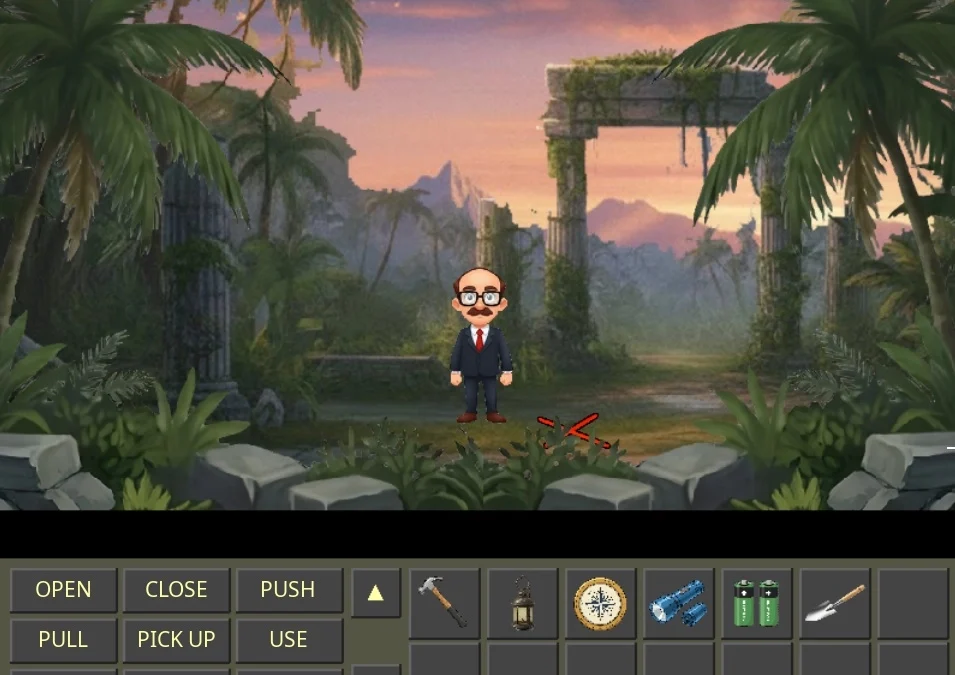
Ever catch yourself daydreaming about building the next Monkey Island, Day of the Tentacle, or Thimbleweed Park? The Point & Click genre is living through a massive renaissance, and today we’re popping the hood on a tool designed specifically to bring that old-school magic back to life: PyCAPGE (Python Classic Adventure Point and Click Game Engine).
Created by Garba, PyCAPGE isn't just a basic template; it’s a robust framework built on Python and Pygame. It bridges the gap between the nostalgic pixel-art aesthetic of the 90s and modern rendering tech. Whether you're a dev looking for a solid codebase or a gamer missing the SCUMM era, here is exactly what makes this engine tick.
What is PyCAPGE?
At its core, PyCAPGE is a modular, open-source engine that smartly separates game logic from game data (scenes, text, configs). The philosophy here is simple: let creators focus on narrative and puzzles while the engine handles the heavy lifting like collision, state management, and movement.
The standout feature? Hybrid Rendering. The engine keeps the game world in a native "retro" resolution (defaulting to 800x638) to preserve that crisp pixel art look, but it renders the UI and text in High Definition (HD) over the scaled window. This means you get the nostalgic vibes without the eye strain—text is always sharp, even on modern 4K monitors.
Tech Specs: Under the Hood
For the developers and code-junkies out there, PyCAPGE boasts some surprisingly sophisticated architecture:
1. A* Pathfinding (Smart Navigation)
Say goodbye to characters moonwalking into walls. PyCAPGE implements a proper navigation system:
-
NavMeshes: Uses grayscale masks (
_bm.jpg) to define exactly where players can and can't walk. -
A Algorithm:* Calculates the shortest path in real-time.
-
Dynamic Obstacles: It’s not static. If an NPC blocks a hallway, the engine updates the navigation graph on the fly, and the player will automatically route around them.
2. Deep Graphic Rendering
The world isn't flat—it just looks that way. The engine handles depth and perspective seamlessly:
-
Dynamic Scaling: Characters automatically zoom in and out based on their Y-position, simulating depth.
-
Z-Sorting: Essential for 2.5D. The engine layers elements correctly so you can walk behind a lamppost but stand in front of a table.
-
Parallax Scrolling: Supports background layers moving at different speeds (
parallax_factors), giving that cinematic 3D feel to 2D environments. -
Dynamic Lighting: Supports lightmaps that tint characters based on their location (e.g., glowing red when standing next to a campfire).
3. Data-Driven Design (YAML)
Hardcoding text is a thing of the past. PyCAPGE decouples content using external .yaml files:
-
Hot-Swappable Localization: Switch languages (English/Spanish/etc.) instantly during gameplay without a restart.
-
Hot Text: Define item descriptions, dialogues, and names strictly in data files, keeping your Python code clean.
4. Finite State Machine (FSM)
The core loop (main.py) runs on a rock-solid state machine that manages:
-
EXPLORE: Free roaming and interaction. -
DIALOGUE: Complex branching conversation trees. -
CUTSCENE: Fully scripted cinematic sequences. -
MAP: Fast-travel interfaces. -
SAVELOAD: robust JSON-based persistence.
Gameplay Features: The Player Experience
PyCAPGE delivers everything a 90s adventure fan expects, plus some modern Quality of Life (QoL) upgrades:
1. The Classic 9-Verb SCUMM Interface
It brings back the legendary LucasArts verb grid: Look, Pick up, Use, Open, Close, Push, Pull, Talk to, Give.
-
Smart Context: The UI highlights the most logical verb when you hover over an object (e.g., "Look at" lights up when hovering over a painting).
-
Sentence Construction: Dynamic sentence building in the status bar (e.g., "Use Hammer with Bell").
2. "Maniac Mansion" Style Character Swapping
This is a power user feature. The engine supports Multiple Protagonists (like Gilo and Bart):
-
Switch control between characters in real-time.
-
Each character has a unique inventory and specific traits (e.g., Bart might be strong enough to lift heavy items Gilo can't).
-
Inactive characters become NPCs you can interact with in the world.
3. Inventory & Crafting
-
Visual Inventory: Big, readable icons.
-
Crafting System: Classic drag-and-drop combination. Dragging batteries onto a flashlight creates a Charged Flashlight.
-
Audio Feedback: Distinct sound effects for grabbing, using, or combining items.
4. Branching Dialogues & Cutscenes
-
Dialogue Trees: Complex conversations where options can deplete ("once": true) or unlock new story branches.
-
Scripted Cutscenes: The
CutsceneManagerallows for movie-like sequences where the player loses control while characters act out a script.
5. Modern Quality of Life
-
Double-Click Exit: Instantly leave a room by double-clicking a door (no waiting for the walk animation).
-
Fast Travel Map: An "Indiana Jones" style map with red lines tracing your path between locations.
-
Save/Load: Unlimited save slots that capture metadata like screenshots, timestamps, and the active character.
The Verdict
PyCAPGE isn't just a coding exercise; it’s a love letter to the genre. It proves that Python, often underestimated in complex game dev, can handle advanced AI, rendering, and state management with elegance.
If you have a story to tell and you miss the golden era of gaming, PyCAPGE puts the technology in your hands. The only thing missing now is your imagination.
Ready to start your adventure?
Download
Images and oficial logos
-
- pycapge_logo_and_subtitle_font2
-
- pycapge_logo_color
-
- pycapge_official_logo_adn_subtitle
-

- pycapge_official_logo_adn_title
-
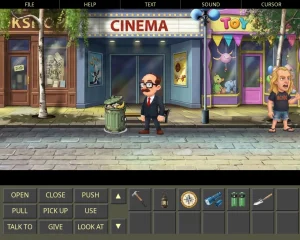
- pyvapge panoramic street
-
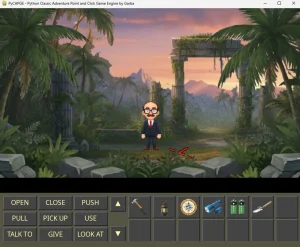
- pyvapge parallax exampleu
-
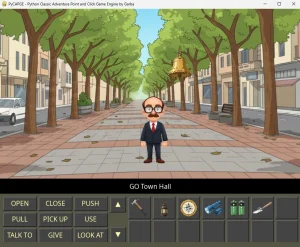
- pyvapge peace avenue
-
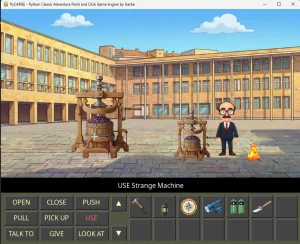
- pyvapge tawn hall